Thursday, May 18, 2017

ICMC17: Control Your Cloud: BYOK is Good, But Not Enough

Matt Landrock, CEO, Cryptomathic

BYOK suggests a one-way mechanism: your key, my cloud.

The word "Key" tends to be generally understood in a very broad sense (symmetric and asymmetric),  however in cloud service providers it has a bit of a different definition.

The current key management servifes offered are MS Azure, Amazon AWS and Google Cloud Platform. Azure uses Thales and Amazon uses Gemalto, Google doesn't appear to use an HSM at this time. Their biggest differences are around the BYOK protocols (key wrapping, etc).

BYOK is an important tool, but should not be the only tool in your tool box.  It will help you get your own key into the cloud, so you know it meets your standards for generation. The cloud provider will handle things for you, but not in a consistent way - so lots of hurdles to go through to get this done.

MYOK - Manage Your Own Keys! MYOK implies you can manage import/export, lifecycle and generation all by yourself. Provision when you need them, destroy when you're done.  How can you do this in a way that is meaningful for your business?

Centralized key managers are moving into the market space.

Key management is more than just keys - name, algorithm, length, export settings. And, many key formats end up being very vendor specific (some use standards like PKCS#8, but many more are just proprietary).


ICMC17: TLS Panel Discussion

Tim Hudson - Cryptsoft
Steve Marquess - OpenSSL
David Hook - Bouincy Castle
Kenn White - Open Crypto Audit
Nicko van Someren - Linux Foundation

There are many implementations of TLS, from C and assembly implementations to Java implementations. OpenSSL has many forks - some obvious, some hidden under the covers. More implementations are good, as we don't want to suffer from monoculture.

There is possible value in creating a drop in API that multiple implementations could use. Nicko suggests creating an open process to create that API - it would not necessarily be from an existing implementation. It could possibly allow for more automation. APIs tend to grow out of necessity, and are not always pretty. A common API could help with security and fuzz testing.

There was then a long side discussion on libsodium (NACL), which is only a crypto library at this point as the "N" piece of networking/TLS hasn't been implemented, yet, but there are lots of language bindings out there.

How long does it take to create a new TLS library?  Apparently a new one was created recently in 3 weeks - leveraging someone else's crypto.  Language choice is important.

The older APIs have to consider legacy deployments, for example OpenSSL still supports VAX/VMS.  Another perspective - a new TLS implementation has taken another team 5 months already. When you have a user base you need to support, that seems to add time to the implementation.

There was a question about moving your implementation from TlS 1.0 to TLS 1.3? One of the OpenSSL developers noted that there is a lot of code reuse, but also a lot of #ifdefs. (TLS 1.0 is not, yet, #ifdef''d out of OpenSSL, but probably will be within the year).

There was a question about what is the biggest issue with FIPS validations? The general answer: consistency. That is, OpenSSL helped take multiple validations through at the same time, which was based on the same code and mostly the same documentation took a different amount of time and got completely different feedbacks.


ICMC17: Inside the OpenSSL 1.1 FIPS Module Project

Tim Hudson, CTO Cryptsoft and Mark Minnoch from SafeLogic.

In July 2016, OpenSSL announced the commencement of a fresh attempt to do a FIPS validation of OpenSSL. There are over 244 validated products on the NIST list that obviously use OpenSSL in their validation boundaries and it's included in most (all?) operating systems - it's pervasive!  So, why is it so hard to validate?  It starts out as open source with lots of competitors/stakeholders interested in it.

Unfortunately, stakeholder goals and project goals do not always align. For example, the project wants to support many platforms - stakeholders want to focus on only one or two. The same goes for the number of algorithms supported and validated.

Previously, FIPS140 work was effectively entirely funded for the OpenSSL project from 2009-2014, as there was no long term or major sponsor at this time.  The sponsors funding OpenSSL FIPS all had different goals (other than wanting to sell into the US government), which made it very difficult to manage. This is a hard project, with many people yelling at you with different goals and wasn't very rewarding - can't just expect people to do this for "fun". [note: yes, nothing about FIPS is "fun" - practical, yes, but not fun]

The first validation was very painful for the developers, so OpenSSL knows they have to do it differently if they are ever going to do it again.  OpenSSL started their first FIPS 140-2 validation in June 2002, certificates were not received until March 2006!

There have been a total of 9 unique validations, to keep up with new hardware platforms and implementation guidance changes.

The OpenSSL FIPS 1.0 module based off of the OpenSSL-0.9.x is no longer usable, there is still a bit of life left in OpenSSL FIPS 2.0 module (#1747, #2389, #2437) as it is based off of the OpenSSL-1.0.x code. But, a major update is required for a new OpenSSL FIPS module to work with OpenSSL-1.1.x.   For this go round, goal is to make the FIPS140 related changes "less intrusive".

Current validations cover dozens (hundreds?) of platforms (OS vs hardware).

For the new validation, the only current sponsor is SafeLogic, but additional sponsors are needed to fund OpenSSL FIPS development and FIPS lab testing - resources are available now to begin work. 

This is a high risk validation, many people will be watching the validation which means people are cautious to enter - which creates a longer timeline. Keep in mind that TLS 1.3 is only available in OpenSSL 1.1.x, so if that's important to your customers, consider helping out financially to get this project going.

It's hard to get the sponsors on board, as they all want to see another sponsor already on board and to share the cost, but they still want to wield great influence over the work.

If this project doesn't happen, there are fewer options for FIPS libraries and will require you to do more of your own FIPS work.  Taking multiple versions from different companies through CAVP/CMVP is a waste of their resources as well.  Also, if everyone develops independently, the federal government will end up with inconsistent implementations.

Originally team was going to work on FIPS 140-2 work before TLSv1.3, but swapped the priorities. That was easier to get a sponsor for, as it's well defined project and now the FIPS work can happen with the TLSv1.3 in place.

OpenSSL has refactored algorithm testing approach and want to better support embedded systems, and do better with entropy generation.  Need to pick up extra NIST work and try to take SHA3 through CAVP/CMVP.

Will continue to look at improvements to POST (like defining what it means for software). Also considering add ChaCha/Poly1305.

Currently cannot commit to many requested features, just due to trying to keep a reasonable timeline.  The current schedule estimate from "start" to certificate is 18months, based on their experience taking other modules through.

Please consider sponsoring this project so it can get off of the ground!


ICMC17: Keynote: Driving Security Improvements in Critical Open Source Projects

Nicko van Someren, CTO, Linux Foundation.

Open Source is huge and it's here to stay, with nearly 4 million contributors world wide, 31 billion lines of committed open source, etc - we aren't getting away from it now! Open Source is the "roads and bridges" of the Internet, which runs on Open Source.

Sometimes open source breaks... things like heartbleed, shellshock, Poodle, etc. The Internet runs on opensource, but it's not always properly looked after. Linus's Law: "Given enough eyeballs, all bugs are shallow" - so why are there still bugs? Well, not enough eyeballs!

Open source software is not more or less secure than closed source - but different. Typically there are more diverse group of people working on the source, but serially over a long period of time. There is often a culture of "code is more important than specification" - a cultural difference from most businesses.

Major projects are very under resourced, like OpenSSL - run  by millions of businesses, but only got $2000 in support in 2013.  NTPD is run by every major stock exchange, but some of the code is 35 years old, maintained by one guy, part time.  Same for bash, GnuPG, and OpenSSH.

These open source projects are not  given the resources they deserve.

The Linux Foundation created the Core Infrastructure Initiative. The CII aims to substantially improve security outcomes in the OSS projects that underpin the Internet. The CII funds work in security engineering, security architecture, tooling and training on key OSS projects.

This market is changing quite quickly as well - who would've known 4 years ago how important node.js would be?

CII is a non profit funded by industry partners, like Intel, Microsoft, Google, Hitatchi, Dell, Cisco, Amazon, Bloomberg, Fujitsu, etc.

Open source can do all of the same things commercial enterprise does for building secure software - just harder, because there is no way to give a top-down mandate (ala Bill Gates fixing security mindset at Microsoft).

Groups and individuals must think about security early and often, it cannot be just one squeaky wheel mentioning security. It requires buy-in from the entire community. Fostering this culture of security within your open source project is the single most important thing that you can do to improve your security outcomes.  Security needs to be given equal weight with scalability, performance, usability and other design factors.

CII is trying to find out where the risks and problems are by doing the CII Census Project to discover the really critical open source projects, how responsive the developers are, historic trends for bug and vuln density and how healthy the development community is. Did a snapshot a couple of years ago and created a scorecard. working now on updating it to be a continuous evaluation.

Once critical projects have issues identified, CII is trying to focus their resources on fixing it. Maintenance work is not fun, but it is vital. They are trying to pay developers to work on key projects full time, match willing and able developers to relevant projects and encourage educational establishments to get students involved.

Additionally, working on improving open source security tools. This means funding development of new or improved OSS security tools, make sure they are usable and have a good signal to noise ratio. Problem with some of the existing tools - terrible documentation! So, there is even a need for paying people to write documentation for how to use and deploy continuous security testing.

CII also wants to drive better security process in OSS projects with their CII Badge program - an open process for evaluating security processes in your community. It's a self assessment, with the goal of avoiding security theater, so it only includes items that really improve security.

CII has a travel fund to send developers to security conferences to learn about security and additional funding to get key OSS developer teams to meet face to face to set priorities and collaborate (like OpenSSL).

If your company is building your business on open source software, you should consider funding those projects and CII to help push better security practices, etc.

Thursday, October 20, 2016

Oracle: Oracle Open Allies, a PFLAG Panel

A panel discussion with PFLAG members: Formerly Parents, Families, and Friends of Lesbians and Gays

Panelists:
Mitzi Henderson, Past National PFLAG President 
Rosemary Malvey, PFLAG Speaker's Bureau (Parent)
Joyce Miller, Straight Spouse Support Group
Windsor Smith, PFLAG San Jose Vice President
Moderated by Cynthia Chin-Lee, OPEN Ally team lead

The event is hosted by Oracle's OPEN group (Oracle Pride Employee Network), a resource for gay, lesbian, transgender, queer and questioning employees.

Cynthia Chin-Lee published a book about Prop 8 called Operation Marriage five years ago, which was since made into a movie! 

Having allies is important, and Oracle is a big ally for their employees. In some US states, you can still be fired for being a homosexual, in some countries you can be killed.


Mitzi Henderson was distressed when she discovered that her church, and other churches, would not provide pastoral services around gay and lesbian issues, which drove her to get involved with PFLAG.

Joyce Miller is a retired nurse and grief counselor, she is a member of the straight spouse support group. Some people were celebrating their gay and lesbian children, but discovered it wasn't always a shared emotion across both parents, which inspired her to get involved in the straight spouse group.

Rosemary Malvey volunteers for Mission Hospice, 12 step programs, and PLFAG. When her son came out to her, she was full of supportive words, but she was full of trepidition about his health, job prospects and safety.  

Windsor Smith attended the Robert E. Lee high school (home of the rebels), and later came out to all of his family and friends in one fell swoop, and quickly learned about various support groups.

Mitzi recalls a terrible story about a gay man arrested in NYC that was arrested and beaten by police just before the gay pride parade, so his mother marched in the parade with a sign asking parents to support their gay children.  She started a support group in NYC, then reached out to other groups and formed a national organization, PFLAG.  They wanted rules that the groups could not be exclusive - ie only for one religion, only for people with gay sons, etc.  It's important for parents to be proud of their children, no matter what their sexual orientation is.

Mitzi had a chance to go to congress to testify on the national issues facing their children to subcommittees in congress. Other research showed that many states had even more restrictive laws than the federal government., and PLFAG is trying to work on this.

When Joyce's son came out to her, when he had finished college and was living abroad, he was very careful to right away to tell her that it was nothing she had done and that it had nothing to do with her recent divorce from his father.  She was concerned about AIDS, at that time it was an out of control epidemic.  She found a lot of support from the other parents in PFLAG. She had been sending her son packages full of pamphlets about AIDS, but she found out that was not going to help her continue to build her relationship with her son.  Her son is now 55 years old and recently married to his partner of 15 years.

Joyce used to handle the hotline phone line for PFLAG for the Bay Area.  She had been getting calls from people who had discovered their husband or wife was actually gay or lesbian.  The straight spouse goes through very different issues than a parent of a gay or lesbian child.  The straight spouse support group doesn't have many "long timers" as it were, as they get their needed healing, they can move on.

Rosemary Malvey has been a PFLAG member for nearly 20 years - she had never heard of PFLAG until she needed PFLAG.   When her son came out to her, he did it by telling her that he was in love and happier than he's ever been.  She was happy he shared this with her, and was very supportive while she was visiting him.  But, after she left, she cried the entire flight home. She worried about her son suffering for his sexual orientation both socially and in his career.  Fortunately, a friend pointed her to PFLAG and told her "it's no big deal" and to get over it.

Rosemary's daughter didn't realize she was a lesbian until she was 35!  Finally, many pieces of her life have fallen into place, and she was finally happy!

Windsor Smith likes being involved with PFLAG and wants people know that they also welcome gay, lesbian and transgender members - not only parents.

A question from the audience: is there a place for siblings to go for support? Resounding answer: PGLAG! Open to all.

A great question about pronouns if your child comes out as transgender. There are many clever pronouns, like "they" in the singular sense, and many other options (zhe/zer/etc). But, the best way is to ask what pronouns the individual prefers.  Some people, including Windsor, put their preferred pronouns in their email signature.

Another question about differing cultural issues - coming out in a conservative culture (religion, ethnicity, etc). If your parents cannot accept you or come to PFLAG, Rosemary still encourages you to go to PFLAG yourself and find a surrogate accepting parent.

PFLAG is a great place to find allies of all sorts. Many of our loved ones are biased, and it's good to challenge them when you can and know you can find an ally.

For younger folks, most junior highs, high schools and colleges have support groups specifically for youths.

At the end of the day, PFLAG is an excellent resource for parents and anyone with questions. If they aren't the right place, they will likely know the direction to point you.

This event was additionally put on to raise money for Equity Florida, the group that has helped many victims of the Orlando shooting.  If you can, please consider donating.


Tuesday, August 30, 2016

OASIS PKCS11 TC Published PKCS#11 2.40 Errata 01 and Header Files!

After we released PKCS#11 2.40, the PKCS11 Technical Committee and our public reviewers found some issues. I'm proud of the work the technical committee did with the public to create  Errata documents for PKCS#11 2.40.

These documents, where created, supersede PKCS#11 v2.40. That is,  if there is an updated constant identifier in the Errata, that should be considered correct.  The PKCS#11 2.40 Usage Guide remains the most up to date, and it is a committee note (not a standard).

In addition to the updated errata documents, we are excited to launch our first official set of header files since moving under the OASIS banner (aka "normative computer language definition files"): pkcs11.h, pkcs11f.h, and pkcs11t.h.

The PKCS11 TC has published Approved Errata for PKCS #11 V2.40. See the announcement at https://www.oasis-open.org/news/announcements/pkcs-11-v2-40-approved-erratas-published-by-pkcs-11-tc or use the links below.

Wednesday, July 6, 2016

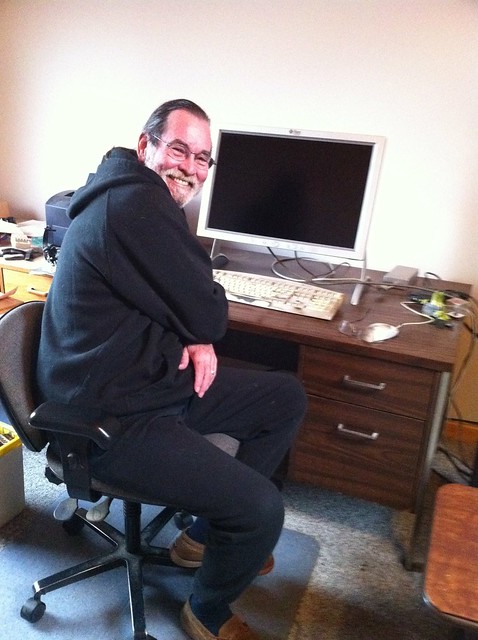
Remembering Roger Faulkner, UNIX Legend

Roger Faulkner, UNIX engineer since 1976, SunOS/Solaris developer since 1990, creator of /procfs, passed away this past weekend.
Photo by Sherry Q. Moore, 2010. 

Roger Faulkner, or raf as his co-workers knew him, was intelligent and had no patience for fools. He was always happy to share history of UNIX, libc, /proc or any other kernel internals, or his opinion on how things should continue to be improved. If you broke the gate in any way shape or form, he'd let you know within a few hours - and if you blocked his project with this breakage, he would not hesitate to let everyone know. He was an amazing colleague with a wry sense of humor and will be missed.   Most folks remember him as that really smart guy that was tough on the outside and sweet, gentle and kind on the inside.  (and seeing that sweet inside wasn't so hard :-)

Roger did not care how senior the engineer (or management) was - he would not let them get away with things that would hurt UNIX or Solaris. He was also always willing to answer questions, do a code review, or help debug an interesting kernel dump. I learned a great deal from him - how to be a good engineer, how to do an excellent root cause analysis, how to know when a bug is really, truly fixed. 

UPDATE July 7, 2016: Obituary is posted here online.  There is a tribute page there as well, where you can leave notes for his family and friends.


UPDATE: July 20, 2016: Roger's Memorial will be livestreamed Saturday 7-23-16, 1p EDT/10a PST/6p BDT.   Streaming will begin 30 mins prior to the memorial service. Youtube channel memorial broadcast:  Memorial Service.


Roger's more extensive bio, courtesy of his manager, Rob Stephens:

Roger grew up in North Carolina and earned a BS in Physics from North Carolina State University in 1963 and a PhD in Physics from Princeton University in 1968. He became involved with UNIX in 1976 when he helped set up and enhance a UNIX service at Bell Labs, Naperville, IL. Roger returned to Bell Labs, Murray Hill, NJ, in 1979 where he continued to work on UNIX development for two years. He moved to New York City in 1981 to do something entirely different for four years, but he couldn't stay away from UNIX. Roger worked at Unix Systems Laboratory 1986-1988 attempting to develop an application debugger for System V Release 3. The result was the first /proc file system for System V and the truss(1) utility for tracing/displaying application-level system calls.

Roger joined Sun Microsystems in 1990 to work on the merge of AT&T's SVr3 and SunOS4.x to create UNIX SVr4 (a.k.a. Solaris 2.0 at Sun). He then concerned himself with the definition, exposure, and maintenance of the Solaris/UNIX process model, with emphasis on visibility into and support for debugging application programs:

From 1990-1993 he extended the ioctl-based /proc interface from being a single-threaded process model to being a multi-threaded process model with lightweight processes within the traditional process.
Roger
Photo by Sherry Q. Moore, 2010

In Solaris 2.6 (1995-1996) Roger created the structured /proc file system, with each entry under /proc being a directory rather than a file, each pid directory under /proc containing individual files and other directories reflecting the full process model for both inspection and control. Programming interfaces defined by the proc(4) manual pages.

In Solaris 8 (1997-1998) Roger created the alternate libthread as a better support library for multi-threading. It is a one-to-one thread/lwp interface rather than the old N-to-M thread/lwp interface implemented in the original Solaris libthread. The alternate libthread become the only threading library in Solaris 9.

In Solaris 10 Roger created the unified process model in which all threading support is folded into libc. All processes became multi-threaded, in principle, eliminating the confusion of having three separate process models as was the case previously. Eliminated static linking of the system libraries; all processes are dynamically linked.

Roger then implemented system changes to enable Solaris 11 to conform to the latest POSIX standard (UNIX V7).

[Solaris 12 work redacted, but let it be known, he's done a lot.]

Roger also lent his expertise to countless Solaris projects and was generous with his time and knowledge as he helped many engineers develop their own expertise about all things UNIX. Roger's dry sense of humor, his chuckle, his irreverence for management, his passion for UNIX, and his inspiration will be missed by everyone who had the privilege to work with him.  Please feel free to share this as it is impossible to include everyone Roger worked with over his many years.

I think Sherry Q. Moore really summed him up in her Facebook post:
 What I learned from Roger:
- You can be brilliant and kind.
- "If you don't have time to do it right, when will you have time to do it over?"
- You can be creative and productive for as long as you want.
- "When you are about to do a putback, if your heart is not pounding, palms not sweating, you shouldn't be doing this (be a kernel engineer) any more."
Meem (Peter Memishian) shared the following (Note: the below source comment can be viewed freely online in context):
Indeed.  Today I lost one of my professional heroes.  As those on PSARC
well know, Roger cast a shadow far beyond his truly immense technical
contributions to UNIX (and Solaris in particular).  His curmudgeonly
outwardness belied a remarkably gentle and caring internal character.
Despite having forgotten more about UNIX than most of us could ever know,
he was as grounded as they come, with a unique style that left indelible
memories on so many of us, and altered the DNA of our engineering culture.

Speaking personally, I've always admired those who prioritize doing over
talking.  Roger was one who quietly moved mountains -- as Bryan captured
in the approval of Roger's RTI which put the final nail in the coffin of
the M-to-N threading model:

  http://dtrace.org/resources/bmc/rti.txt  

And of course, Roger wasn't afraid to speak his mind when necessary --
as captured in this gem above cv_wait_stop():

 /*
  * Same as cv_wait(), but wakes up (after wakeup_time milliseconds) to check
  * for requests to stop, like cv_wait_sig() but without dealing with signals.
  * This is a horrible kludge.  It is evil.  It is vile.  It is swill.
  * If your code has to call this function then your code is the same.
  */

Finally, I'd like to share this mail from many moons ago on the history of
the name "truss", which embodied the soul that he infused into his work.

 | From: "Roger A. Faulkner" <Roger.Faulkner@Eng>
 | To: meem@Eng
 | Subject: Re: curiosity: truss?
 | Date: Wed, 27 Jan 1999 23:34:47 -0800 (PST)
 |
 | For your edification, this is the geneaology of the name "truss"
 | (taken from some mail dated Sep 26, 1988)
 | This was when Ron Gomes and I were jointly developing the first
 | /proc for SVR4 at USL.
 | -----------------------------------------------------------------
 |
 | We considered, and discarded, several alternative names for truss(1),
 | including "trace", before settling on "truss".  The objection to
 | "trace" is that it's too generic a term and shouldn't be co-opted
 | for a specific use like this; there are lots of other things that
 | one might trace.  Among the alternate names we considered were:
 | "ptrace"  (but this incorrectly implies a connection with ptrace(2)),
 | "strace"  (but this is already used for some streams tracing thing),
 | "tss"     for "trace syscalls and signals" (but this is certainly bad),
 | "sst"     a permutation of "tss" (but this implies it's blinding fast),
 | "trss"    another variation of "tss" (but this is unpronouncable).
 | Adding the obvious vowel gave us "truss", which can be construed
 | to mean "TRace Unix Syscalls and Signals".
 |  
 | "truss" seems to have the right combination of mnemonic value
 | and disrespect for authority ("If your program doesn't work, put
 | it in a truss.")  It conjures up a mental image which is fairly
 | accurate, considering what the program does.

Rest in Peace, Roger.  May all your RTIs be promptly approved. 
Tim Foster did an in memoriam integration into the ON gate for Roger. He will live in Solaris forevermore.

Below are some tweets I saw passing by.... Please share your own thoughts below, or send to me and I will share them here.


Do you have any memories of raf? Please share in the comments or in your own space.

We are collecting pictures for his family and friends in the Roger Flickr group. Please add your own there.

Don't worry Roger, someone will approve your RTI.